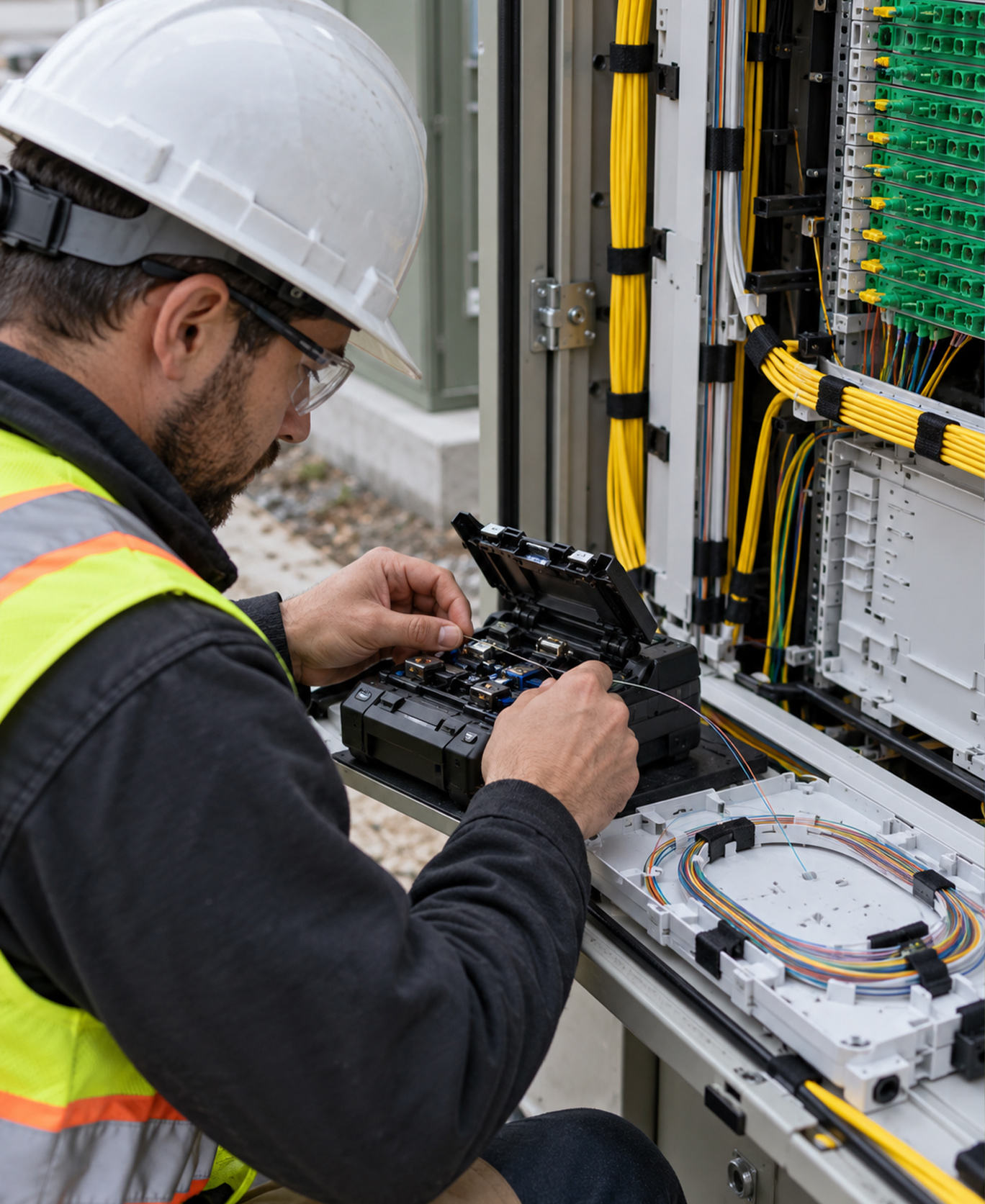
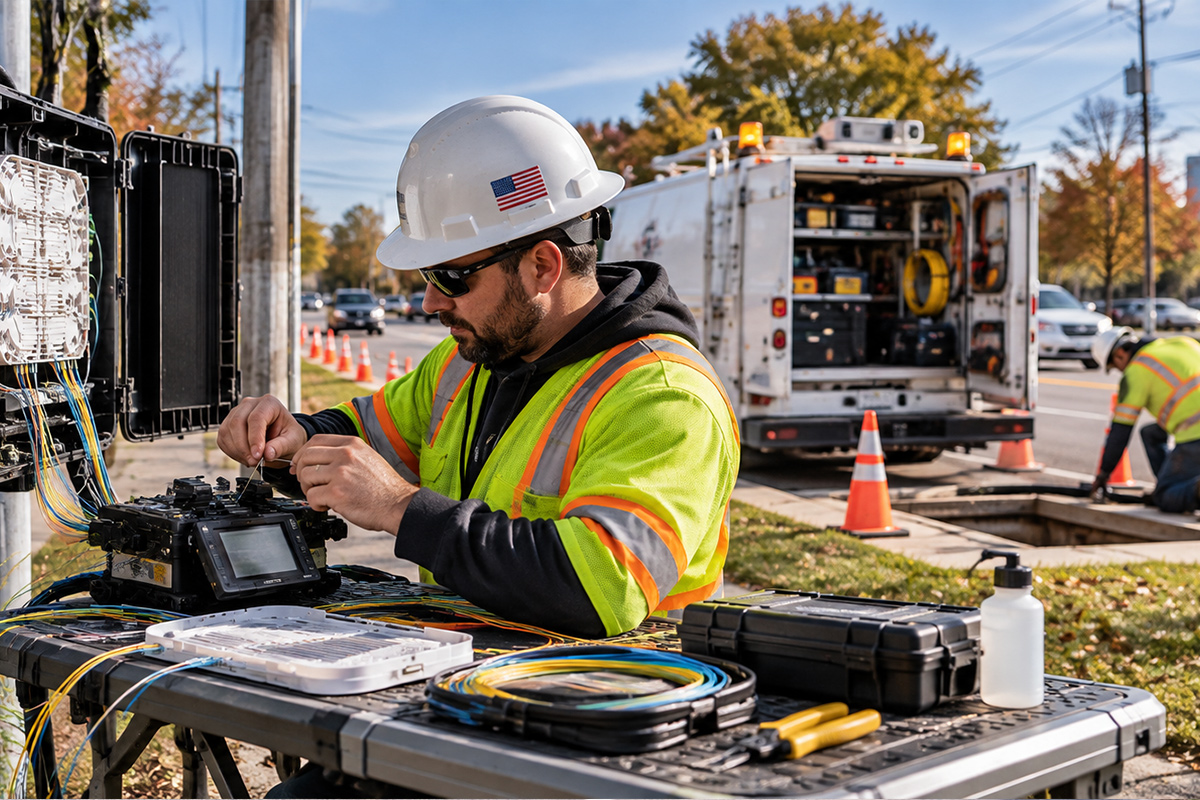
Single-Fiber Splicing
Precision Splicing for Individual Fiber Connections
Linix Tech provides single-fiber splicing for telecommunications, data center, commercial, and critical infrastructure environments where individual fiber strands must be connected, repaired, extended, or managed independently.
From new construction and network expansion to repairs, upgrades, and infrastructure transitions, our teams support precise fiber connections with careful preparation, organized fiber management, testing, and project closeout.
Single-fiber splicing connects individual fiber strands one at a time.
This approach provides a high level of control when specific fibers need to be connected, modified, repaired, or extended without affecting the entire fiber group.
It is commonly used in projects where flexibility, selective fiber management, and precise connection work are important.

Single-Fiber Splicing Capabilities
Fusion Splicing
Precision fusion splicing creates permanent fiber connections by accurately aligning and joining individual strands.
Linix Tech supports fusion splicing for new installations, network expansion, repairs, infrastructure upgrades, and connectivity changes.
Fiber Preparation
Reliable splicing starts with proper preparation.
Our process may include:
- Fiber organization
- Stripping
- Cleaning
- Cleaving
- Alignment
- Splice preparation
- Fiber identification
Careful preparation helps support consistent splice quality.
Splice Tray & Closure Management
Completed splices must be protected and organized.
Linix Tech supports fiber management within splice trays, closures, cabinets, and other network infrastructure to help maintain accessibility and long-term organization.
Fiber Repair & Restoration
Damaged or failed fiber connections can interrupt network performance.
Linix Tech supports single-fiber repair and resplicing for projects involving:
- Damaged fibers
- Failed connections
- Route modifications
- Fiber extensions
- Infrastructure repairs
- Network restoration work
Network Expansion
Existing networks often require individual fibers to be extended or connected as capacity grows.
Single-fiber splicing provides the flexibility needed to add or modify specific connections without changing the entire fiber group.
Testing & Verification
Splicing should be verified before project closeout.
Depending on the scope, Linix Tech supports:
- Connectivity verification
- Loss testing
- Fault identification
- Troubleshooting
- Fiber validation
- Test documentation
Documentation & Closeout
Accurate records help support future maintenance and network changes.
Project documentation may include:
- Fiber identification
- Splice records
- Testing results
- Connectivity information
- Labeling
Applications for Single-Fiber Splicing
Linix Tech supports single-fiber splicing across a range of infrastructure environments, including:
- Aerial fiber networks
- Underground fiber networks
- Data center connectivity
- Commercial facilities
- Telecom infrastructure
- Network expansions
- Infrastructure upgrades
- Fiber repairs
- Migration projects
Single-Fiber Splicing for Aerial Networks
Aerial fiber routes often require individual strand connections at splice points, distribution locations, route extensions, and network transitions.
Linix Tech supports single-fiber splicing as part of aerial fiber construction, expansion, repair, and maintenance projects.
Single-Fiber Splicing for Underground Networks
Underground fiber infrastructure may require individual splices at handholes, vaults, cabinets, building entrances, or other transition points.
Linix Tech can coordinate underground infrastructure and single-fiber splicing within a broader project scope.
Single-Fiber Splicing for Data Centers
Data center environments often require precise fiber connectivity between racks, network systems, distribution points, and supporting infrastructure.
Linix Tech supports single-fiber splicing as part of:
- Data center deployment
- Structured cabling
- GPU infrastructure
- Network expansion
- Migration
- Infrastructure upgrades
A Coordinated Splicing Process
Assess
01
Review fiber type, cable count, splice locations, existing infrastructure, and connectivity requirements.
Prepare
02
Organize the work area, identify fibers, prepare cables and strands, and set up splicing equipment.
Splice
03
Complete individual fiber connections according to project requirements.
Organize
04
Protect and manage completed splices within trays, closures, cabinets, or related infrastructure.
Test & Validate
05
Verify connectivity and fiber performance and address identified issues.
Document & Close Out
06
Complete required splice records, testing information, labeling, and project documentation.
Single-fiber splicing is well suited for projects that require:
- Precise control over individual connections
- Selective fiber repair
- Network modifications
- Fiber extensions
- Infrastructure upgrades
- Smaller or distributed splice counts
- Individual strand troubleshooting
- Flexible network changes
Single-fiber splicing connects one fiber strand at a time, providing greater flexibility for selective work and individual fiber management.
Ribbon splicing connects multiple fibers together in a single operation and is generally better suited for high-fiber-count environments where speed and deployment efficiency are important.
Linix Tech supports both methods based on the requirements of the project.
Fiber splicing is a small physical connection with a major impact on network performance.
Clean preparation, accurate alignment, organized fiber management, proper protection, testing, and documentation all contribute to long-term reliability.
Linix Tech approaches single-fiber splicing with attention to each of these stages.
- Precise Field Execution
- Multi-Environment Capability
- Construction + Splicing Support
- Testing & Closeout
Testing, verification, labeling, and documentation help complete the transition from physical splice work to operational connectivity.
Planning a new fiber build, repair, route expansion, network upgrade, data center connection, or infrastructure modification?
Tell us about your project location, fiber type, approximate fiber count, scope, and timeline.